
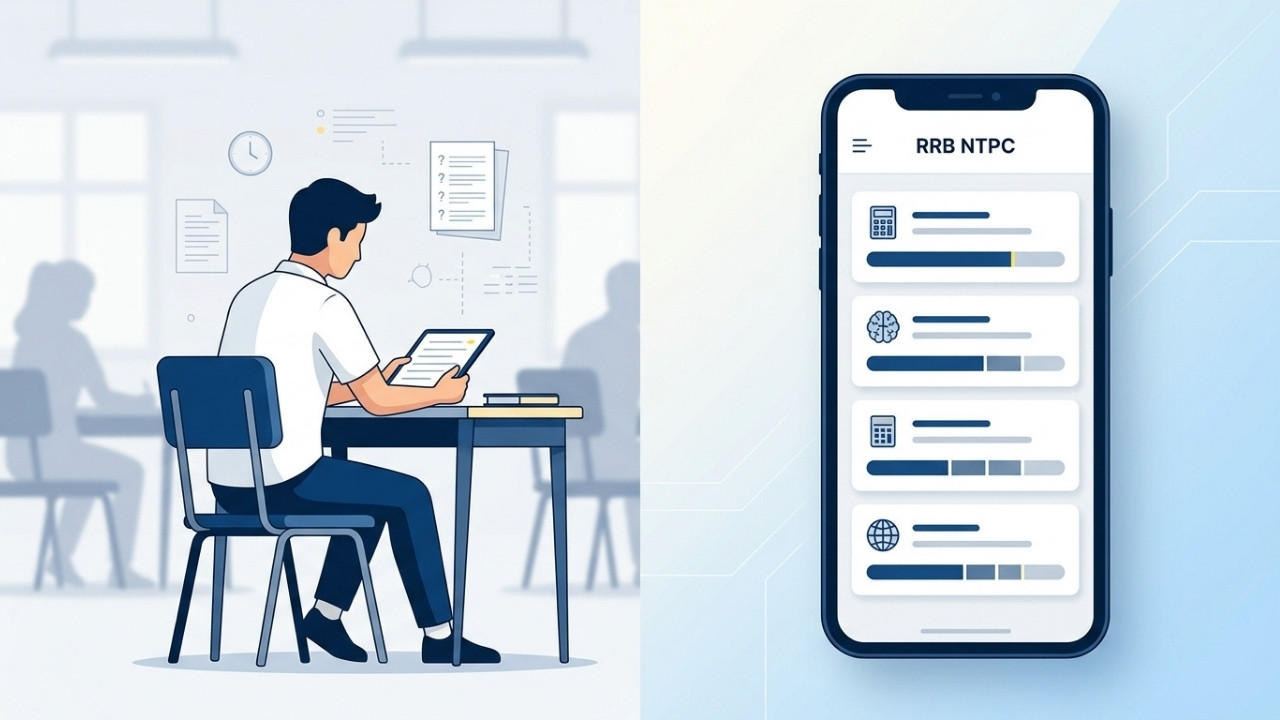
The Railway Recruitment Board NTPC examination continues to be one of India’s largest recruitment cycles, with participation often crossing one crore candidates. As the CBT-1 phase for 2026 moves closer, clarity around the exam scheme is not just useful; it is operationally necessary for serious aspirants.
RRB NTPC does not follow a single-test selection model. Instead, it applies a layered filtration system where early stages eliminate bulk candidates, and later stages determine final merit. This structure makes it essential to understand how each stage functions in relation to the overall selection pipeline.
Table of Contents
Selection Structure: How the Process Progresses

The recruitment process is divided into multiple stages that gradually narrow down the candidate pool. It begins with CBT-1, which primarily acts as a screening test. Candidates who qualify move to CBT-2, which is significantly more competitive and plays a major role in final selection.
Depending on the post, candidates may then face a skill-based stage. For clerical positions, this is typically a typing skill test, while posts such as Station Master or Traffic Assistant require a computer-based aptitude test. The final steps include document verification and a medical examination to ensure eligibility and fitness standards.
This multi-layered approach ensures that only candidates with consistent performance across stages reach the final merit list.
CBT-1 Exam Pattern: First-Level Screening
The first stage is uniform across all posts and is designed to test fundamental aptitude.
Exam Structure
| Section | Questions | Marks |
|---|---|---|
| General Awareness | 40 | 40 |
| Mathematics | 30 | 30 |
| General Intelligence & Reasoning | 30 | 30 |
| Total | 100 | 100 |
- Duration: 90 minutes
- Mode: Online (Computer-Based Test)
- Negative Marking: 1/3 mark deduction per wrong answer
Practical Insight
CBT-1 is qualifying in nature, but competition makes it highly selective. Historically, only a fraction (often around 15–20 times vacancies) moves to CBT-2, indicating a sharp elimination ratio.
CBT-2 Exam Pattern: Core Merit Stage
Candidates clearing CBT-1 move to CBT-2, which is more intensive and post-specific.
Detailed Structure
| Section | Questions | Marks |
|---|---|---|
| General Awareness | 50 | 50 |
| Mathematics | 35 | 35 |
| General Intelligence & Reasoning | 35 | 35 |
| Total | 120 | 120 |
- Duration: 90 minutes
- Negative Marking: 1/3 mark per wrong answer
- Difficulty Level: Higher than CBT-1
Main Difference from CBT-1
While subjects remain the same, CBT-2 focuses on:
- Deeper conceptual questions
- Higher analytical reasoning
- Increased weightage on General Awareness
Final merit is primarily based on CBT-2 performance.
Marking Scheme & Normalisation System
The scoring framework is straightforward in structure but complex in impact due to normalisation. Each correct answer adds one mark, while each incorrect answer results in a deduction of 0.33 marks. Unattempted questions do not attract any penalty.
Since the examination is conducted in multiple shifts across the country, a normalisation process is applied to ensure fairness. This adjusts scores based on the relative difficulty level of each shift, which can significantly influence final results.
Subject-Wise Weightage Trend
Across both CBT stages, the syllabus remains consistent:
- Mathematics
- General Intelligence & Reasoning
- General Awareness
However, General Awareness often carries the highest scoring potential, especially in CBT-2.
Skill Test / CBAT: Post-Specific Stage
Not all candidates appear in this stage. It depends on the applied post:
- Typing Skill Test (TST): Required for clerical roles
- Computer-Based Aptitude Test (CBAT): Required for Station Master, Traffic Assistant
Typing requirements:
- 30 WPM (English)
- 25 WPM (Hindi)
These tests are usually qualifying but mandatory.
Data Insights: Scale of Competition
RRB NTPC is among India’s most competitive exams:
- Previous recruitment cycles saw over 1 crore applicants across categories
- Vacancy-to-candidate ratio often exceeds 1:200 or higher
- Shortlisting ratio: CBT-1 filters candidates roughly 15–20 times the vacancies
This makes speed and accuracy in CBT-1 as critical as depth in CBT-2.
Where Most Candidates Go Wrong
A common strategic error among aspirants is treating CBT-1 and CBT-2 with the same preparation approach. In practice, these stages demand different execution models.
CBT-1 is largely about clearing the cut-off efficiently. It rewards speed, precision, and intelligent question selection. Over-attempting without accuracy often leads to negative marking losses that prove costly.
CBT-2, however, shifts the focus toward depth and consistency. Here, balanced performance across all sections becomes essential, as sectional weaknesses can directly impact final ranking.
Understanding this distinction is important. Candidates who adapt their preparation strategy accordingly tend to perform more consistently across stages.
What This Means for 2026 Aspirants
With CBT-1 exams already scheduled and admit cards expected around exam phases, candidates should align preparation strictly with the exam structure:
- Focus on mock test-based preparation
- Prioritise General Awareness for scoring advantage
- Build sectional balance to avoid cut-off failure
Given the scale and normalisation system, even small score differences can significantly impact rank positioning.